

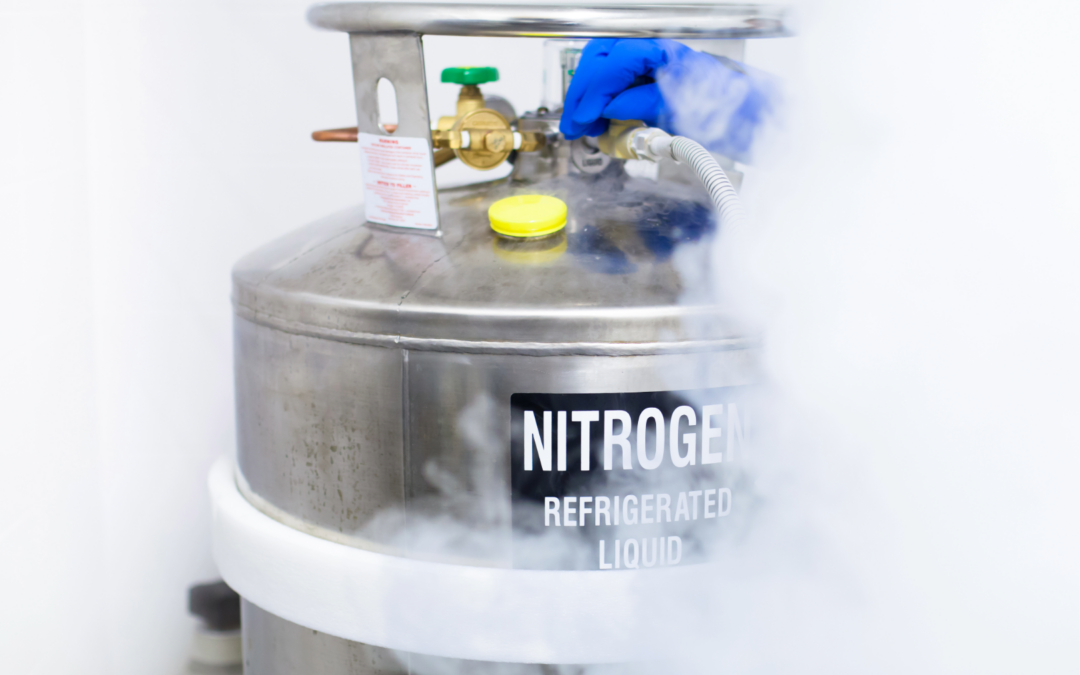
There is no single standard liquid nitrogen price for industrial users. The cost depends on how much nitrogen is required, how frequently it is delivered, the type of storage equipment used and the location of the customer.
For businesses that rely on nitrogen as part of manufacturing, processing, freezing, cooling or laboratory operations, the cost of the product itself is only one part of the overall supply arrangement.
Understanding these variables makes it easier to compare quotations and determine the most appropriate nitrogen supply option for a particular process.
What is liquid nitrogen?
Liquid nitrogen is nitrogen that has been cooled to approximately -196°C at atmospheric pressure, at which point it exists as a cryogenic liquid.
Its extremely low temperature makes it suitable for applications requiring rapid or controlled cooling. Industrial uses can include:
- Food freezing and chilling
- Laboratory and scientific applications
- Pharmaceutical and biotechnology processes
- Manufacturing
- Shrink fitting
- Temperature control
- Process cooling
Liquid nitrogen requires specialist cryogenic storage and handling equipment because it continually absorbs heat from its surroundings and boils back into gaseous nitrogen.
What determines the liquid nitrogen price?
Several factors contribute to the price paid by an industrial customer.
Volume
Consumption is one of the most significant factors.
A business requiring occasional small quantities will have a very different supply arrangement from a manufacturing facility consuming large volumes continuously.
Higher-volume users may be able to use larger storage systems and scheduled deliveries, changing the effective cost per unit compared with smaller requirements.
Delivery frequency
Transport and logistics contribute to the overall cost of liquid nitrogen.
Businesses requiring frequent deliveries need to consider the complete delivered cost rather than simply comparing the underlying nitrogen price.
Accurate consumption forecasting can help establish an appropriate delivery schedule and reduce the risk of unnecessary deliveries or interruptions to supply.
Storage equipment
Liquid nitrogen must be stored in purpose-designed cryogenic equipment.
Depending on consumption, this could range from smaller portable vessels to larger cryogenic storage systems.
Equipment rental, installation, maintenance and associated infrastructure can therefore influence the overall cost of nitrogen supply.
Location
The distance between the supply point and customer affects transport costs.
For businesses comparing a liquid nitrogen price, it is therefore important to establish whether quotations include delivery and any associated logistics charges.
Supply arrangements
Contract terms, minimum order quantities, delivery schedules and equipment agreements can all influence the final cost.
For procurement teams, comparing like-for-like quotations is essential.
Liquid nitrogen cylinder or cryogenic vessel?
The phrase liquid nitrogen cylinder is frequently used when searching online, although liquid nitrogen is normally stored and transported in specialist cryogenic vessels rather than conventional compressed gas cylinders.
These vessels are designed to maintain the extremely low temperatures required for liquid nitrogen.
The appropriate storage system depends on factors including:
- Consumption
- Required flow
- Frequency of use
- Available site space
- Delivery arrangements
- Application
Businesses should consider the complete storage and delivery system when assessing the cost of liquid nitrogen.
Liquid nitrogen or nitrogen gas cylinder?
Whether a business requires liquid nitrogen or a nitrogen gas cylinder depends on the application.
Compressed gaseous nitrogen is commonly supplied in cylinders for applications where relatively modest quantities of nitrogen gas are required.
Applications can include:
- Purging
- Inerting
- Pressure testing
- Controlled atmospheres
- Manufacturing processes
Liquid nitrogen may be more appropriate where cryogenic temperatures are required or where consumption makes liquid storage and vaporisation a practical alternative to multiple compressed gas cylinders.
The lowest headline product price does not necessarily represent the lowest operating cost. Consumption, storage, handling and delivery should be assessed together.
Liquid nitrogen and dry ice are not the same
Dry ice is sometimes considered alongside liquid nitrogen for industrial cooling, freezing and temperature-controlled applications, but the two products are fundamentally different.
Liquid nitrogen is nitrogen in its cryogenic liquid state. Dry ice is solid carbon dioxide.
Dry ice has a temperature of approximately -78.5°C and sublimates directly from a solid into carbon dioxide gas. Liquid nitrogen is significantly colder and boils into nitrogen gas as it warms.
The choice between them depends on the application.
Dry ice can be particularly useful for temporary cooling and temperature-controlled transportation because it can be used without a cryogenic liquid storage system.
Liquid nitrogen is suited to processes requiring significantly lower temperatures or the specific characteristics of nitrogen.
Businesses should select the cooling medium according to process requirements rather than price alone.
Why nitrogen consumption matters
For regular industrial users, understanding actual nitrogen consumption is one of the most useful steps towards controlling costs.
A supply review should consider:
- Current monthly or annual consumption
- Peak demand
- Number of cylinders currently used
- Frequency of deliveries
- Product losses
- Storage capacity
- Future production requirements
A business using increasing numbers of nitrogen gas cylinders may eventually reach a point where an alternative supply arrangement becomes more practical.
Conversely, a company with relatively low consumption may find that cylinders remain the most appropriate option.
The importance of supply reliability
Nitrogen is often a process-critical product.
An interruption can affect production, testing, packaging, cooling or other operations, making security of supply an important consideration alongside price.
When assessing a nitrogen supplier, businesses should consider:
- Product availability
- Delivery reliability
- Lead times
- Technical knowledge
- Ability to respond to changing demand
- Supply contingency
- Communication
For critical industrial processes, a slightly lower nitrogen price offers limited value if unreliable supply creates production downtime.
Comparing liquid nitrogen prices
When requesting quotations, procurement teams should provide enough information for suppliers to assess the requirement accurately.
Useful information includes:
Required product and specification
Confirm whether the process requires liquid nitrogen or gaseous nitrogen and whether a particular grade is needed.
Estimated consumption
Provide expected weekly, monthly or annual usage where possible.
Delivery location
This enables logistics to be incorporated into the quotation.
Current storage arrangement
Explain whether suitable cryogenic storage is already installed.
Delivery frequency
Existing delivery information can help identify whether the current arrangement is efficient.
Application
Understanding how nitrogen is being used can help determine whether the proposed supply method is appropriate.
A quotation based on the complete requirement provides a more useful comparison than an isolated price for the nitrogen itself.
Frequently asked questions
How much does liquid nitrogen cost in the UK?
There is no universal liquid nitrogen price. Costs vary according to quantity, delivery location, frequency of supply, storage arrangements and contractual requirements. Industrial users should request a quotation based on their actual consumption and application.
Can you buy liquid nitrogen in a cylinder?
Liquid nitrogen requires specialist cryogenic storage. Although the term liquid nitrogen cylinder is commonly used, the equipment is different from a conventional compressed nitrogen gas cylinder.
What is the difference between liquid nitrogen and nitrogen gas?
They are the same element in different physical states. Liquid nitrogen is cryogenic nitrogen maintained at extremely low temperatures, while gaseous nitrogen can be supplied compressed in cylinders or generated from stored liquid nitrogen through vaporisation.
Is liquid nitrogen the same as dry ice?
No. Liquid nitrogen is cryogenic nitrogen, while dry ice is solid carbon dioxide. They have different temperatures, handling requirements and applications.
Is liquid nitrogen cheaper than nitrogen cylinders?
This depends on consumption and the overall supply arrangement. Cylinders can be practical for lower-volume applications, while alternative supply arrangements may become more economical as nitrogen consumption increases.
What information is needed for a nitrogen quotation?
A supplier will typically need to understand the required nitrogen grade, consumption, application, delivery location, storage facilities and expected delivery frequency.
Review your nitrogen supply requirements
If your business is reviewing nitrogen costs, increasing its consumption or looking for a more reliable industrial gas supply arrangement, speak to Blended Products.
Our team can discuss your application, expected volumes, delivery requirements and current supply arrangement to help identify an appropriate solution.
Contact Blended Products to discuss your nitrogen requirements and request a quotation.